Description:
Configuring automatic logon for Firefox, for Microft Office SharePoint Server (MOSS) URLs
Solution:
1.
Open Firefox
2.
Address Bar: Type about:config
When prompted for a warning, click "I'll be careful I promise"
3.
About:config > Preference Name > network.automatic-ntlm-auth.trusted-uris
Right-click and "Modify"
4.
Entering String Value Dialog Box
Type the URL addresses of the SharePoint web applications (use comma to separate multiple addresses)
E.g. https://portal.domain.com, https://search.domain.com
Click "OK"
For information about more advanced Firefox/MOSS integration, read Mauro's recent blog post:
SharePoint/Office Integration with Firefox
Tuesday, March 24, 2009


Tuesday, March 17, 2009
SQL Server: How to Change the Default Database Location
Description:
Instructions for changing the default Database locations.
Solution:
1. Open SQL Server Management Studio
2. Right Click on the SQL Server Instance node > Properties
3. Navigate to the "Database Settings" menu
4. Modify the "Database default locations"
5. Restart the following Windows Service:
SQL Server (MSSQLSERVER)
6. Create a new test database to verify that it is being created in the new, default location
Instructions for changing the default Database locations.
Solution:
1. Open SQL Server Management Studio
2. Right Click on the SQL Server Instance node > Properties
3. Navigate to the "Database Settings" menu
4. Modify the "Database default locations"
5. Restart the following Windows Service:
SQL Server (MSSQLSERVER)
6. Create a new test database to verify that it is being created in the new, default location
SharePoint 3.0: How to Move SQL Database Files, Transaction Log Files to Different Disk Location
Description:
Instructions for moving database files (mdf) and transaction log files (ldf) to a different disk drive on the database server, in a MOSS 2007 server farm.
Solution:
1. Perform the necessary capacity planning analyses and tasks to ensure that the future configuration will perform and scale for growth.
2. Schedule a maintenance window to allow for enough time to perform the configuration changes and test the SharePoint portal after the changes are complete. Communicate the maintenance window appropriately to the business users.
3. Create folders on the destination disk drive for storing the files. If the servers are physical, consider storing the transaction log files on a separate physical disk from the database files, to maximize performance. If the servers are virtual, understand the disk configuration of the underlying servers to ensure considerations including disk performance, contention, scalability, and snapshots.
In this example, D:\MSSQL_Data is the destination of data files, and D:\MSSQL_TLogs is the destination of transaction log files.
4. On the MOSS web front end servers and the Index server, stop the following Windows Services:
WWW Publishing Service
Windows SharePoint Administration
Windows SharePoint Search
Windows SharePoint Timer
Windows SharePoint Tracing
Windows SharePoint VSS Writer
Office SharePoint Search
5. For each database that is being moved, run the SQL Commands below to take the database offline
SQL Server Management Studio > New Query
--------------------
ALTER DATABASE MOSS_ContentDatabase SET OFFLINE;
GO
--------------------
6. Using Windows Explorer, physically copy the mdf and ldf files of the databases to their new location.
7. Run the SQL Commands below to update the physical location of the database files
SQL Server Management Studio > New Query
--------------------
USE master;
GO
ALTER DATABASE MOSS_ContentDatabaseMODIFY FILE (NAME = MOSS_ContentDatabase, FILENAME = 'D:\MSSQL_Data\MOSS_ContentDatabase.mdf');
GO
ALTER DATABASE MOSS_ContentDatabaseMODIFY FILE (NAME = MOSS_ContentDatabase_log, FILENAME = 'D:\MSSQL_TLogs\MOSS_ContentDatabase_log.ldf');
GO
ALTER DATABASE MOSS_ContentDatabase
SET ONLINE
GO
--------------------
8. Verify that the updated location has been properly set for each database by running the command below:
SQL Server Management Studio > New Query
--------------------
USE master;
GO
SELECT name, physical_name
FROM sys.master_files
WHERE database_id = DB_ID('MOSS_ContentDatabase');
GO
--------------------
Instructions for moving database files (mdf) and transaction log files (ldf) to a different disk drive on the database server, in a MOSS 2007 server farm.
Solution:
1. Perform the necessary capacity planning analyses and tasks to ensure that the future configuration will perform and scale for growth.
2. Schedule a maintenance window to allow for enough time to perform the configuration changes and test the SharePoint portal after the changes are complete. Communicate the maintenance window appropriately to the business users.
3. Create folders on the destination disk drive for storing the files. If the servers are physical, consider storing the transaction log files on a separate physical disk from the database files, to maximize performance. If the servers are virtual, understand the disk configuration of the underlying servers to ensure considerations including disk performance, contention, scalability, and snapshots.
In this example, D:\MSSQL_Data is the destination of data files, and D:\MSSQL_TLogs is the destination of transaction log files.
4. On the MOSS web front end servers and the Index server, stop the following Windows Services:
WWW Publishing Service
Windows SharePoint Administration
Windows SharePoint Search
Windows SharePoint Timer
Windows SharePoint Tracing
Windows SharePoint VSS Writer
Office SharePoint Search
5. For each database that is being moved, run the SQL Commands below to take the database offline
SQL Server Management Studio > New Query
--------------------
ALTER DATABASE MOSS_ContentDatabase SET OFFLINE;
GO
--------------------
6. Using Windows Explorer, physically copy the mdf and ldf files of the databases to their new location.
7. Run the SQL Commands below to update the physical location of the database files
SQL Server Management Studio > New Query
--------------------
USE master;
GO
ALTER DATABASE MOSS_ContentDatabaseMODIFY FILE (NAME = MOSS_ContentDatabase, FILENAME = 'D:\MSSQL_Data\MOSS_ContentDatabase.mdf');
GO
ALTER DATABASE MOSS_ContentDatabaseMODIFY FILE (NAME = MOSS_ContentDatabase_log, FILENAME = 'D:\MSSQL_TLogs\MOSS_ContentDatabase_log.ldf');
GO
ALTER DATABASE MOSS_ContentDatabase
SET ONLINE
GO
--------------------
8. Verify that the updated location has been properly set for each database by running the command below:
SQL Server Management Studio > New Query
--------------------
USE master;
GO
SELECT name, physical_name
FROM sys.master_files
WHERE database_id = DB_ID('MOSS_ContentDatabase');
GO
--------------------
Monday, January 19, 2009
SharePoint 3.0: Is the Installation 32 bit or 64 bit?
If you have an installation of Microsoft Office SharePoint Server 2007 and you are trying to determine whether it is 32 bit or 64 bit, here are a couple ways you can do it:
* Task Manager; OWSTIMER.EXE
64 bit: OWSTIMER.EXE if it is 64 bit
32 bit: OWSTIMER32.EXE if it is 32 bit
* Windows Explorer; Program Files
64 bit: Installation directory is \Program files\common files\microsoft shared\web server extensions\12\
32 bit: Installation directory is \Program files (x86)\common files\microsoft shared\web server extensions\12\
* Task Manager; OWSTIMER.EXE
64 bit: OWSTIMER.EXE if it is 64 bit
32 bit: OWSTIMER32.EXE if it is 32 bit
* Windows Explorer; Program Files
64 bit: Installation directory is \Program files\common files\microsoft shared\web server extensions\12\
32 bit: Installation directory is \Program files (x86)\common files\microsoft shared\web server extensions\12\
Friday, January 09, 2009
Event: Focus On Series: Optimize Your SharePoint Investment

On Tuesday, Feburary 24, 2009 I will be presenting at an event sponsored by Vitale Caturano. For more information or to register, please follow this link: http://www.vitale.com/sharepoint
Tuesday, December 02, 2008
SharePoint 3.0: Search Results: How to Add a Document Properties Hyperlink
Introduction
As for a document appearing in SharePoint 3.0 search results; the standard formatting includes a hyperlink to open the document. However, you may want your search results to also include a link to open the display form or edit form of the document's associated list item. This way users have the options of opening a document as well as viewing and editing document properties all from the search results page.
Step 1. Crawl the Item ID Crawled Property
* SharePoint Shared Services Administration > Search Settings > Metadata Property Mappings > Crawled Properties
* Search for ows_ID(Integer)
* Edit/Map Property: ows_ID
* Mappings to managed properties: Check to "Include values for this property in the search index"
* Click OK
Step 2. Create a Managed Property for the Document's List Item ID
* SharePoint Shared Services Administration > Search Settings > Metadata Property Mappings > Managed Properties
* New Managed Property
Name and type
Property Name: OWSIDInteger
Description:
The type of information in this property: Integer
Mappings to crawled properties: Select - Include values from a single crawled property based on the order specified
Crawled properties mapped to this managed property: OWS_ID(Integer)
Use in scopes: No - Do not allow this property to be used in scopes
Step 4. Make the New Managed Property Part of the Search Query
* Search Center site collection > search results page > search results web part > edit web part > Modify Shared Web Part
* Web part tool pane > Results Query Options > Selected Columns:
Modify the XML of Selected Columns to include the new managed property, OWSIDInteger
Reference:
How to: Change the Properties Returned in the Core Search Results
http://msdn2.microsoft.com/en-us/library/ms560074.aspx
Step 6. Test the Search Query to Ensure the New Managed Property is Returning Values
* Search Center site collection > search results page > search results web part > edit web part > Modify Shared Web Part
* Web part tool pane >Miscellaneous > XSL Editor:
Modify the XML so it returns raw XML results
Reference:
How to: View Search Results XML Data
http://msdn2.microsoft.com/en-us/library/ms546985.aspx
Step 5. Make the Managed Property Display in the Search Results
5A. Create an XML File Containing the Raw XML Representation of the Search Results
* Open an XML editor such as Visual Studio
* File > New > File > XML File
* Search Center > Perform a search (the results should still be coming back as raw XML)
* Copy the search results into the XML file
* Save the XML file to be used in Step 5B
5B. Create a new XSL Stylesheet
* Create a test site
* Add a Data View Web Part (DVWP) to the Test Site
* SharePoint Designer > Open test site > Open default.aspx
* Split View
* Menu > Insert > SharePoint Controls > Data View
* Data Source Library > XML Files > Add an XML file:
Upload the XML file from Step 5A
* Drag the content from the new data source to the DVWP
* Format the DVWP accoding to the desired look and feel for search results
* When look and feel is complete, open the XML editor and create a new XML file:
Visual Studio > File > New > File > XML File
* SharePoint Designer > Highlight the DVWP in the Design window
* Copy the code for the DVWP from the Code view
* Paste the XML into the new XML file
* Identify the XSL Stylesheet portion of the XML
* Cut away any unnecessary XML from the file, leaving only the XSL Stylesheet
* Save the XML file to be used in Step 5C
5C. Apply the new XSL Stylesheet to the Search Results Web Part
* Visual Studio > Open file:
Open the XML file created in Step 5B
* Search Center site collection > search results page > search results web part > edit web part > Modify Shared Web Part
* Web part tool pane >Miscellaneous > XSL Editor:
Open the XSL Editor
* Paste the XML from Visual Studio into the XSL Stylesheet, overwriting the existing stylesheet
* Click OK
As for a document appearing in SharePoint 3.0 search results; the standard formatting includes a hyperlink to open the document. However, you may want your search results to also include a link to open the display form or edit form of the document's associated list item. This way users have the options of opening a document as well as viewing and editing document properties all from the search results page.
Step 1. Crawl the Item ID Crawled Property
* SharePoint Shared Services Administration > Search Settings > Metadata Property Mappings > Crawled Properties
* Search for ows_ID(Integer)
* Edit/Map Property: ows_ID
* Mappings to managed properties: Check to "Include values for this property in the search index"
* Click OK
Step 2. Create a Managed Property for the Document's List Item ID
* SharePoint Shared Services Administration > Search Settings > Metadata Property Mappings > Managed Properties
* New Managed Property
Name and type
Property Name: OWSIDInteger
Description:
The type of information in this property: Integer
Mappings to crawled properties: Select - Include values from a single crawled property based on the order specified
Crawled properties mapped to this managed property: OWS_ID(Integer)
Use in scopes: No - Do not allow this property to be used in scopes
Step 3. Run a Full Crawl
* SharePoint Shared Services Administration > Search Settings > Content sources and crawl schedules > For each applicable content source, invoke the context menu and Start Full CrawlStep 4. Make the New Managed Property Part of the Search Query
* Search Center site collection > search results page > search results web part > edit web part > Modify Shared Web Part
* Web part tool pane > Results Query Options > Selected Columns:
Modify the XML of Selected Columns to include the new managed property, OWSIDInteger
Reference:
How to: Change the Properties Returned in the Core Search Results
http://msdn2.microsoft.com/en-us/library/ms560074.aspx
Step 6. Test the Search Query to Ensure the New Managed Property is Returning Values
* Search Center site collection > search results page > search results web part > edit web part > Modify Shared Web Part
* Web part tool pane >Miscellaneous > XSL Editor:
Modify the XML so it returns raw XML results
Reference:
How to: View Search Results XML Data
http://msdn2.microsoft.com/en-us/library/ms546985.aspx
Step 5. Make the Managed Property Display in the Search Results
5A. Create an XML File Containing the Raw XML Representation of the Search Results
* Open an XML editor such as Visual Studio
* File > New > File > XML File
* Search Center > Perform a search (the results should still be coming back as raw XML)
* Copy the search results into the XML file
* Save the XML file to be used in Step 5B
5B. Create a new XSL Stylesheet
* Create a test site
* Add a Data View Web Part (DVWP) to the Test Site
* SharePoint Designer > Open test site > Open default.aspx
* Split View
* Menu > Insert > SharePoint Controls > Data View
* Data Source Library > XML Files > Add an XML file:
Upload the XML file from Step 5A
* Drag the content from the new data source to the DVWP
* Format the DVWP accoding to the desired look and feel for search results
* When look and feel is complete, open the XML editor and create a new XML file:
Visual Studio > File > New > File > XML File
* SharePoint Designer > Highlight the DVWP in the Design window
* Copy the code for the DVWP from the Code view
* Paste the XML into the new XML file
* Identify the XSL Stylesheet portion of the XML
* Cut away any unnecessary XML from the file, leaving only the XSL Stylesheet
* Save the XML file to be used in Step 5C
5C. Apply the new XSL Stylesheet to the Search Results Web Part
* Visual Studio > Open file:
Open the XML file created in Step 5B
* Search Center site collection > search results page > search results web part > edit web part > Modify Shared Web Part
* Web part tool pane >Miscellaneous > XSL Editor:
Open the XSL Editor
* Paste the XML from Visual Studio into the XSL Stylesheet, overwriting the existing stylesheet
* Click OK
Tuesday, October 28, 2008


Tuesday, October 07, 2008

SharePoint 3.0: Error: Crawl Log "The object was not found."
Description:
Unable to crawl a web site content source.
Error: "The object was not found. (The item was deleted because it was either not found or the crawler was denied access to it.)"
Unable to crawl a web site content source.
Error: "The object was not found. (The item was deleted because it was either not found or the crawler was denied access to it.)"

Solution:
Determine if the web site is case sensitive. If so, implement the configuration changes described in the following KB article:
You cannot crawl case-sensitive Web content in SharePoint Server 2007
http://support.microsoft.com/kb/932619
Keywords:
Crawling case sensitive web sites; MOSS 2007; Crawl jsp pages; How to crawl .jsp pages with SharePoint; Case-Sensitive; sharepoint search jsp; sharepoint search .jsp
Wednesday, September 24, 2008
Links: Microsoft Windows Server 2008
Windows Server 2008: System Requirements
http://www.microsoft.com/windowsserver2008/en/us/system-requirements.aspx
Windows Server 2008: Overview of Editions
http://www.microsoft.com/windowsserver2008/en/us/editions-overview.aspx
Windows Server 2008: Compare Features
http://www.microsoft.com/windowsserver2008/en/us/compare-features.aspx
Windows Server 2008: Compare Server Roles
http://www.microsoft.com/windowsserver2008/en/us/compare-roles.aspx
Links: Microsoft SQL Server 2008
MSDN: SQL Server 2008 Books Online: Product Specifications for SQL Server 2008
http://msdn.microsoft.com/en-us/library/ms143287.aspx
MSDN: SQL Server 2008 Books Online: Hardware and Software Requirements for Installing SQL Server 2008
http://msdn.microsoft.com/en-us/library/ms143506.aspx
MSDN: SQL Server 2008 Books Online: Maximum Number of Processors Supported by the Editions of SQL Server 2008
http://msdn.microsoft.com/en-us/library/ms143760.aspx
MSDN: SQL Server 2008 Books Online: SQL Server 2008 Books Online: Memory Supported by the Editions of SQL Server 2008
http://msdn.microsoft.com/en-us/library/ms143685.aspx
MSDN: SQL Server 2008 Books Online: Maximum Capacity Specifications for SQL Server 2008
http://msdn.microsoft.com/en-us/library/ms143432.aspx
MSDN: SQL Server 2008 Books Online: Editions and Components of SQL Server 2008
http://msdn.microsoft.com/en-us/library/ms144275.aspx
MSDN: SQL Server 2008 Books Online: Features Supported by the Editions of SQL Server 2008
http://msdn.microsoft.com/en-us/library/cc645993.aspx
MSDN: SQL Server 2008 Books Online: Using Upgrade Advisor to Prepare for Upgrades
http://msdn.microsoft.com/en-us/library/ms144256.aspx
MSDN: SQL Server 2008 Books Online: Getting SQL Server Assistance
http://msdn.microsoft.com/en-us/library/ms166016.aspx
MSDN: SQL Server 2008 Books Online: Planning a SQL Server Installation
http://msdn.microsoft.com/en-us/library/bb500442.aspx
MSDN: SQL Server 2008 Books Online: Overview of SQL Server Installation
http://msdn.microsoft.com/en-us/library/bb500438.aspx
MSDN: SQL Server 2008 Books Online: How to: Install SQL Server 2008 (Setup)
http://msdn.microsoft.com/en-us/library/ms143219.aspx
MSDN: SQL Server 2008 Books Online: How to: Upgrade to SQL Server 2008 (Setup)
http://msdn.microsoft.com/en-us/library/ms144267.aspx
MSDN: SQL Server 2008 Books Online: Migrating to SQL Server 2008
http://msdn.microsoft.com/en-us/library/bb677619.aspx
MSDN: SQL Server 2008 Books Online: Backward Compatibility
http://msdn.microsoft.com/en-us/library/cc280407.aspx
http://msdn.microsoft.com/en-us/library/ms143287.aspx
MSDN: SQL Server 2008 Books Online: Hardware and Software Requirements for Installing SQL Server 2008
http://msdn.microsoft.com/en-us/library/ms143506.aspx
MSDN: SQL Server 2008 Books Online: Maximum Number of Processors Supported by the Editions of SQL Server 2008
http://msdn.microsoft.com/en-us/library/ms143760.aspx
MSDN: SQL Server 2008 Books Online: SQL Server 2008 Books Online: Memory Supported by the Editions of SQL Server 2008
http://msdn.microsoft.com/en-us/library/ms143685.aspx
MSDN: SQL Server 2008 Books Online: Maximum Capacity Specifications for SQL Server 2008
http://msdn.microsoft.com/en-us/library/ms143432.aspx
MSDN: SQL Server 2008 Books Online: Editions and Components of SQL Server 2008
http://msdn.microsoft.com/en-us/library/ms144275.aspx
MSDN: SQL Server 2008 Books Online: Features Supported by the Editions of SQL Server 2008
http://msdn.microsoft.com/en-us/library/cc645993.aspx
MSDN: SQL Server 2008 Books Online: Using Upgrade Advisor to Prepare for Upgrades
http://msdn.microsoft.com/en-us/library/ms144256.aspx
MSDN: SQL Server 2008 Books Online: Getting SQL Server Assistance
http://msdn.microsoft.com/en-us/library/ms166016.aspx
MSDN: SQL Server 2008 Books Online: Planning a SQL Server Installation
http://msdn.microsoft.com/en-us/library/bb500442.aspx
MSDN: SQL Server 2008 Books Online: Overview of SQL Server Installation
http://msdn.microsoft.com/en-us/library/bb500438.aspx
MSDN: SQL Server 2008 Books Online: How to: Install SQL Server 2008 (Setup)
http://msdn.microsoft.com/en-us/library/ms143219.aspx
MSDN: SQL Server 2008 Books Online: How to: Upgrade to SQL Server 2008 (Setup)
http://msdn.microsoft.com/en-us/library/ms144267.aspx
MSDN: SQL Server 2008 Books Online: Migrating to SQL Server 2008
http://msdn.microsoft.com/en-us/library/bb677619.aspx
MSDN: SQL Server 2008 Books Online: Backward Compatibility
http://msdn.microsoft.com/en-us/library/cc280407.aspx
Friday, August 29, 2008
SharePoint 3.0: Site Users Web Part
The Site Users Web Part can be used to enhance the appearance of a SharePoint site by displaying a list of users who belong to the site. This web part works well on collaborative sites such as project sites or team sites, when the site permissions have been configured with either SharePoint groups or where users are added directly to site permissions access control list of the site.
Environments that also have Live Communication Server have an opportunity to promote IM to their users since the users' precense information is displayed and the context menu allows users to easily spawn IM sessions.
The Site Users Web Part is less useful on sites that have lots of users or when Active Directory groups are being used to provision access to the site. Since the Site Users Web Part does not enumerate user names who are members of Active Directory groups, these display only as group names.
Site Users Web Part Configuration Options:
Show people and groups with direct permissions on this site.
This displays a list of users who have been added directly to site permissions for the site. The person's full name with presence information is shown.
Show people in this site's members groupThis lets you display the names of people who belong to the Site Members, default SharePoint group.
The person's full name with presence information is shown.
Show people in the group:
This lets you select a SharePoint group to display the names of people who belong to that group. The person's full name with presence information is shown.
Monday, August 25, 2008
SharePoint 3.0: Manage Access Requests
Access Requests are a feature of SharePoint that allow users to submit an email, to a SharePoint administrator, requesting access to a resource (site or list) that they are denied access to.
The email to the administrator provides the username, the URL of the resource, and comments directly from the user. The email looks like this:
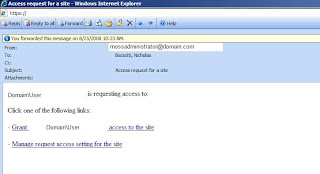
Resources that inherit security from their parent will automatically inherit the parent's Access Request setting. If you break inheritance at a list, then the list permissions, settings menu will appear and an Access Request menu item will be available. This allows you to set an Access Request email address, different from the parent site. This behavior is not true for list items. If you break security inheritance at a list item, an Access Request menu option does not appear on the list item security settings menu.
Here are some best practices for configuring Access Requests:
* Use a dedicated distribution group for this purpose
* Since each unique site collection can have its own Access Request email address, give the distribution group a generic name so that it can be used accross many site collections
* Definitely don't use a service account's email address because no real person is on the other end to receive the request
* Don't use an individual user's email address, doing so would result in a single point of failure
* If you are maintaining instruction documentation that describes the steps to configure a new site collection in your environment, then add "configure access requests email address" as a step..doing so will be a good reminder to do it.
How to configure Manage Access Requests email address:
* Site Collection > Site Actions > Site Settings > Modify All Site Settings > Advanced Permissions
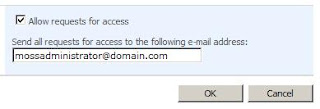
* Settings > Access Requests
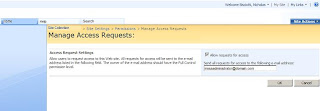
* Set email address, click OK
The email to the administrator provides the username, the URL of the resource, and comments directly from the user. The email looks like this:

Resources that inherit security from their parent will automatically inherit the parent's Access Request setting. If you break inheritance at a list, then the list permissions, settings menu will appear and an Access Request menu item will be available. This allows you to set an Access Request email address, different from the parent site. This behavior is not true for list items. If you break security inheritance at a list item, an Access Request menu option does not appear on the list item security settings menu.
Here are some best practices for configuring Access Requests:
* Use a dedicated distribution group for this purpose
* Since each unique site collection can have its own Access Request email address, give the distribution group a generic name so that it can be used accross many site collections
* Definitely don't use a service account's email address because no real person is on the other end to receive the request
* Don't use an individual user's email address, doing so would result in a single point of failure
* If you are maintaining instruction documentation that describes the steps to configure a new site collection in your environment, then add "configure access requests email address" as a step..doing so will be a good reminder to do it.
How to configure Manage Access Requests email address:
* Site Collection > Site Actions > Site Settings > Modify All Site Settings > Advanced Permissions
* Settings > Access Requests

* Set email address, click OK

Thursday, August 21, 2008
SharePoint 3.0: Error: Calculated Site Column, Formula Contains a Syntax Error
Description:
When attempting to create a new calculated site column...
...inside the formula, you reference a column name in brackets, such as Year[created]...
...and you are unable to save the new site column, instead you receive an error.
Error:
The formula contains a syntax error or is not supported.
Troubleshoot issues with Windows SharePoint Services.

Solution:
Use parentheses around the brackets. E.g. Year([Created])
Wednesday, August 20, 2008
SharePoint 3.0: Error: The specified name is already in use
Description:
Site Collection > Site Settings > Site Collection Features
When attempting to activate the following:
Office SharePoint Server Publishing Infrastructure
Provides centralized libraries, content types, master pages and page layouts and enables page scheduling and other publishing functionality for a site collection.
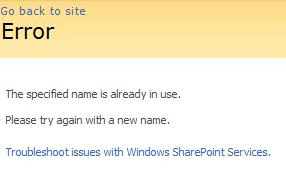
Error:
The specified name is already in use. Please try again with a new name. Troubleshoot issues with Windows SharePoint Services.
Solution:
When publishing features are enabled, SharePoint automatically creates a bunch of objects on the site. It is possible that before you attempted to activate publishing on your site, you had already created an object, such as a library, list, site column, or content type using a name that SharePoint uses. With publishing deactivated, SharePoint does not enforce naming contstraints on these names so it is possible for you to create, for example, a library called Pages (creating a future conflict) not knowing that SharePoint will automatically create a Pages library when you activate publishing.
If you can, audit the SharePoint site comparing it with another site that already has publishing enabled to see if you can find a conflict.
If you are unable to locate the conflict, and you need to activate publishing features, you can force the activation by running the following command:
stsadm.exe -o activatefeature -filename publishing\feature.xml -url http://%URL% -force
stsadm.exe -o activatefeature -filename publishingresources\feature.xml -url http://%URL% -force
stsadm.exe -o activatefeature -filename publishingsite\feature.xml -url http://%URL% -force
stsadm.exe -o activatefeature -filename publishingweb\feature.xml -url http://%URL% -force
stsadm.exe -o activatefeature -filename publishinglayouts\feature.xml -url http://%URL% -force
stsadm.exe -o activatefeature -filename navigation\feature.xml -url http://%URL% -force
Site Collection > Site Settings > Site Collection Features
When attempting to activate the following:
Office SharePoint Server Publishing Infrastructure
Provides centralized libraries, content types, master pages and page layouts and enables page scheduling and other publishing functionality for a site collection.
Error:
The specified name is already in use. Please try again with a new name. Troubleshoot issues with Windows SharePoint Services.

Solution:
When publishing features are enabled, SharePoint automatically creates a bunch of objects on the site. It is possible that before you attempted to activate publishing on your site, you had already created an object, such as a library, list, site column, or content type using a name that SharePoint uses. With publishing deactivated, SharePoint does not enforce naming contstraints on these names so it is possible for you to create, for example, a library called Pages (creating a future conflict) not knowing that SharePoint will automatically create a Pages library when you activate publishing.
If you can, audit the SharePoint site comparing it with another site that already has publishing enabled to see if you can find a conflict.
If you are unable to locate the conflict, and you need to activate publishing features, you can force the activation by running the following command:
stsadm.exe -o activatefeature -filename publishing\feature.xml -url http://%URL% -force
stsadm.exe -o activatefeature -filename publishingresources\feature.xml -url http://%URL% -force
stsadm.exe -o activatefeature -filename publishingsite\feature.xml -url http://%URL% -force
stsadm.exe -o activatefeature -filename publishingweb\feature.xml -url http://%URL% -force
stsadm.exe -o activatefeature -filename publishinglayouts\feature.xml -url http://%URL% -force
stsadm.exe -o activatefeature -filename navigation\feature.xml -url http://%URL% -force
Friday, August 15, 2008
Thursday, July 24, 2008

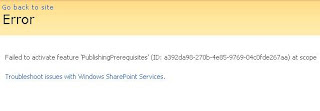
SharePoint V3: Error: Failed to activate feature 'PublishingPrerequisites'
Description:
Receiving error when attempting to activate the Office SharePoint Server Publishing Infrastructure, site collection feature:
Error: Failed to activate feature 'PublishingPrerequisites'
Solution:
- Run IISReset on the front end web servers
Start > Run > CMD > iisreset /noforce
- Activate the feature
Site Actions > Site Settings > Site Collection Features > Office SharePoint Server Publishing Infrastructure > Activate
Receiving error when attempting to activate the Office SharePoint Server Publishing Infrastructure, site collection feature:
Error: Failed to activate feature 'PublishingPrerequisites'

Solution:
- Run IISReset on the front end web servers
Start > Run > CMD > iisreset /noforce
- Activate the feature
Site Actions > Site Settings > Site Collection Features > Office SharePoint Server Publishing Infrastructure > Activate
Wednesday, July 23, 2008
SharePoint V3: Search: “The search request was unable to connect to the Search Service”
Description:
Error: “The search request was unable to connect to the Search Service”
Event Log has errors referencing a corrupt index.
Solution:
* Reset index
SSP Administration > Search Settings > Reset all crawled content
* Perform a full crawl
SSP Administration > Search Settings > Content Sources > Perform a full crawl
Error: “The search request was unable to connect to the Search Service”
Event Log has errors referencing a corrupt index.
Solution:
* Reset index
SSP Administration > Search Settings > Reset all crawled content
* Perform a full crawl
SSP Administration > Search Settings > Content Sources > Perform a full crawl
SharePoint V3: How to Rename and Migrate a Content Database From a SQL Express Farm to a SQL Server SE or EE Farm
Here are the steps to follow if you need to migrate (SQL upgrade would be a different approach from this) a SharePoint content database from one farm which has SQL Server Express 2005 to a separate farm which has SQL Server SE or EE 2005.
* Verify the number of site collections in the content database you are planning to migrate
- Launch SharePoint Central Adminsitration from the SQL Express Farm
- SharePoint Central Administration > Application Management > Content Databases > contentdb_old > Current Number of Sites >
The number of site collections will appear. Note this number.
* If the SQL Express Farm is active, notify the users of maintenance
* Stop services
- Control Panel > Services > Stop the following services:
WWW Publishing Service
SQL Server Service
* Copy the data and log files from the source database server's data directory to destination database server's data directory
E.g.
Program Files\Microsoft SQL Server\MSSQL.1\MSSQL\Data\contentdb_old.mdf
Program Files\Microsoft SQL Server\MSSQL.1\MSSQL\Data\contentdb_old_log.ldf
* Rename the data and log files
E.g.
Program Files\Microsoft SQL Server\MSSQL.1\MSSQL\Data\contentdb_new.mdf
Program Files\Microsoft SQL Server\MSSQL.1\MSSQL\Data\contentdb_new_log.ldf
* Attach the databaseSQL Server Management Studio > right click databases node > select "Attach"
-Attach a Database > Click "Add"Browse to the SQL data file > Select contentdb_new.mdf
-Attach Databases > Databases to Attach > Attach As column> Modify the "Attach As" name to contentdb_new
-Attach Databases > Databases to Attach > Owner column > Modify the "Owner" name
-Attach Databases > Database Details > Current File Path > Modify the data file location and name (contentdb_new.mdf)
-Attach Databases > Database Details > Current File Path > Modify the log file location and name (contentdb_new_log.ldf)
-Click "OK"
* Create a new SharePoint web application on SQL Server SE or EE farm
- SharePoint Central Administration > Application Management > Create or Extend Web Application
- Configure the web application directory location and IIS application pool names according to naming convention
- Name the default content database "deleteme" as it will be deleted in the next step
* Delete the default content database
-SharePoint Central Administration > Application Management > Content Databases > Click the "deleteme" content databaseManage Content Database Settings for "deleteme" > Click "Remove Content Database" > Click "OK"
-SQL Server Management Studio > Databases > right click "deleteme" database > Click "Delete"
-Check "Delete backup and restore history information for databases"
-Check "Close existing connections"
-Click "OK"
* Configure alternate access mappings for the new web application
- SharePoint Central Administration > Operations > Alternate Access Mappings > Add all of the necessary AAM's to the new web application, make sure the default URL is fully qualified
* Configure DNS
- Active Directory > DNS > Configure the necessary host (a) records or alias records
* Configure IIS Host Headers
-IIS Management > Right Click Web Site > Properties > Web Site Tab > Click "Advanced"
-Add the appropriate host headers to match the alternate access mappings
* Attach migrated content database to the new web application
- Start > Run > CMD > Type the following:
C:\Program Files\Common Files\Microsoft Shared\web server extensions\12\BIN> Stsadm.exe -o addcontentdb -url http://webapplication -databasename contentdb_new -databaseserver servername
* Run IISReset
- Start > Run > CMD > Type the following:
iisreset /restart
* Verify the number of site collections in the content database that has been migrated
- Launch SharePoint Central Adminsitration from the SQL Express Farm
- SharePoint Central Administration > Application Management > Content Databases > contentdb_new > Current Number of Sites
You will now see the content database you migrated. The number of sites should match the number of sites in the source content database.
* Perform follow up tasks
- Since the migration is now complete, it is ok to start the WWW Publishing and SQL Server services on the SQL Express farm
- Verify the new web application by navigating the its URL
- Recreate audiences on the new farm's SSP and then re-configure audiences accordingly on web parts used throughout the migrated site collection
- Verify and update hyperlinks throughout the migrated site collection
- Notify users that the web application has been migrated and that it has a new URL
* Verify the number of site collections in the content database you are planning to migrate
- Launch SharePoint Central Adminsitration from the SQL Express Farm
- SharePoint Central Administration > Application Management > Content Databases > contentdb_old > Current Number of Sites >
The number of site collections will appear. Note this number.
* If the SQL Express Farm is active, notify the users of maintenance
* Stop services
- Control Panel > Services > Stop the following services:
WWW Publishing Service
SQL Server Service
* Copy the data and log files from the source database server's data directory to destination database server's data directory
E.g.
Program Files\Microsoft SQL Server\MSSQL.1\MSSQL\Data\contentdb_old.mdf
Program Files\Microsoft SQL Server\MSSQL.1\MSSQL\Data\contentdb_old_log.ldf
* Rename the data and log files
E.g.
Program Files\Microsoft SQL Server\MSSQL.1\MSSQL\Data\contentdb_new.mdf
Program Files\Microsoft SQL Server\MSSQL.1\MSSQL\Data\contentdb_new_log.ldf
* Attach the databaseSQL Server Management Studio > right click databases node > select "Attach"
-Attach a Database > Click "Add"Browse to the SQL data file > Select contentdb_new.mdf
-Attach Databases > Databases to Attach > Attach As column> Modify the "Attach As" name to contentdb_new
-Attach Databases > Databases to Attach > Owner column > Modify the "Owner" name
-Attach Databases > Database Details > Current File Path > Modify the data file location and name (contentdb_new.mdf)
-Attach Databases > Database Details > Current File Path > Modify the log file location and name (contentdb_new_log.ldf)
-Click "OK"
* Create a new SharePoint web application on SQL Server SE or EE farm
- SharePoint Central Administration > Application Management > Create or Extend Web Application
- Configure the web application directory location and IIS application pool names according to naming convention
- Name the default content database "deleteme" as it will be deleted in the next step
* Delete the default content database
-SharePoint Central Administration > Application Management > Content Databases > Click the "deleteme" content databaseManage Content Database Settings for "deleteme" > Click "Remove Content Database" > Click "OK"
-SQL Server Management Studio > Databases > right click "deleteme" database > Click "Delete"
-Check "Delete backup and restore history information for databases"
-Check "Close existing connections"
-Click "OK"
* Configure alternate access mappings for the new web application
- SharePoint Central Administration > Operations > Alternate Access Mappings > Add all of the necessary AAM's to the new web application, make sure the default URL is fully qualified
* Configure DNS
- Active Directory > DNS > Configure the necessary host (a) records or alias records
* Configure IIS Host Headers
-IIS Management > Right Click Web Site > Properties > Web Site Tab > Click "Advanced"
-Add the appropriate host headers to match the alternate access mappings
* Attach migrated content database to the new web application
- Start > Run > CMD > Type the following:
C:\Program Files\Common Files\Microsoft Shared\web server extensions\12\BIN> Stsadm.exe -o addcontentdb -url http://webapplication -databasename contentdb_new -databaseserver servername
* Run IISReset
- Start > Run > CMD > Type the following:
iisreset /restart
* Verify the number of site collections in the content database that has been migrated
- Launch SharePoint Central Adminsitration from the SQL Express Farm
- SharePoint Central Administration > Application Management > Content Databases > contentdb_new > Current Number of Sites
You will now see the content database you migrated. The number of sites should match the number of sites in the source content database.
* Perform follow up tasks
- Since the migration is now complete, it is ok to start the WWW Publishing and SQL Server services on the SQL Express farm
- Verify the new web application by navigating the its URL
- Recreate audiences on the new farm's SSP and then re-configure audiences accordingly on web parts used throughout the migrated site collection
- Verify and update hyperlinks throughout the migrated site collection
- Notify users that the web application has been migrated and that it has a new URL
Monday, July 14, 2008
SharePoint V3: Disk Cache
One performance configuration available in MOSS 2007 is BlobCache. Consider caching files on the front end web servers to improve performance. Open the web.config for the web application and review the BlobCache settings.
BlobCache location="C:\blobCache" ...
References:
Configure disk-based cache settings
http://office.microsoft.com/en-us/sharepointserver/HA101762841033.aspx
Custom Caching Overview
http://msdn.microsoft.com/en-us/library/aa589700.aspx
BlobCache location="C:\blobCache" ...
References:
Configure disk-based cache settings
http://office.microsoft.com/en-us/sharepointserver/HA101762841033.aspx
Custom Caching Overview
http://msdn.microsoft.com/en-us/library/aa589700.aspx
SharePoint V3: Error: The path specified cannot be used at this time.
Description:
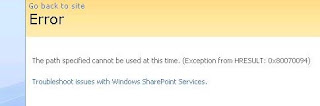
When attempting to create a web application, receiving error:
"Error: The path specified cannot be used at this time."
When attempting to create a web application, receiving error:
"Error: The path specified cannot be used at this time."

Solution:
1. Central Administration > Application Management > Delete a Web Application: Delete the web application that errored upon creation
2. Start > Run > iisreset /restart
3. Attempt creating the web application again
3. Attempt creating the web application again
Wednesday, July 09, 2008
Links: Microsoft TechNet: White papers for MOSS 2007
Microsoft TechNet: White papers for Office SharePoint Server 2007
http://technet.microsoft.com/en-us/library/cc262733(TechNet.10).aspx
http://technet.microsoft.com/en-us/library/cc262733(TechNet.10).aspx
Tuesday, July 08, 2008
SharePoint 3.0: Default Search Relevance by File Type
The Search engine in SharePoint 3.0 considers certain file types more relevant than others. Below is a list of file types in sequence of most relevant to least relevant.
- Web Pages
- PowerPoint Presentations
- Word Documents
- Emails
- XML Files
- Excel Files
- Text Files
- SharePoint List Items
Thursday, July 03, 2008
SharePoint V3: Error: No results matching your search were found
Description:
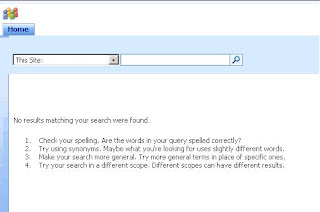
When performing a contextual search (WSS Search) from a SharePoint 3.0 site, no results are returned. Error: No results matching your search were found.
Are you using SSL?
Are you using a network load balancer?
Are there multiple domains in the environment?
Are the web applications accessible from outside the organization?
Solution:
Central Administration > Operations > Alternate Access Mappings
* Ensure that the Pubic URL for the web application if fully qualified
* Ensure that all possible URLs for the web application are configured in the default (or appropriate) zone
e.g.
https://sharepoint.domain.com
http://sharepoint.domain.com
https://sharepoint
http://sharepoint
When performing a contextual search (WSS Search) from a SharePoint 3.0 site, no results are returned. Error: No results matching your search were found.

Are you using SSL?
Are you using a network load balancer?
Are there multiple domains in the environment?
Are the web applications accessible from outside the organization?
Solution:
Central Administration > Operations > Alternate Access Mappings
* Ensure that the Pubic URL for the web application if fully qualified
* Ensure that all possible URLs for the web application are configured in the default (or appropriate) zone
e.g.
https://sharepoint.domain.com
http://sharepoint.domain.com
https://sharepoint
http://sharepoint
Wednesday, July 02, 2008
SharePoint V3 Error: Absolute path information required
Description:
When attempting to create a new web application from Central Administration, Error: Absolute path information required
When attempting to create a new web application from Central Administration, Error: Absolute path information required

Solution:
Jai's SharePoint Blog: The dreaded ‘Absolute path information required’ - Some light in the darkness http://sharepoint.jai-world.com/archives/6
Download and run the utility. It is intuitive and effective.Tuesday, July 01, 2008
SharePoint V3: How to Delete a Master Page from Master Page Gallery
Description:
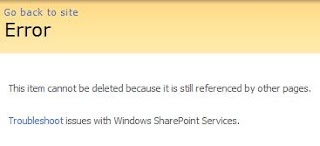
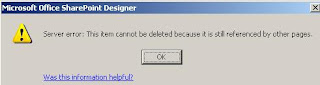
When attempting to delete a master page from the master page gallery, error: "This item cannot be deleted because it is still referenced by other pages"
Error from browser
Error from SharePoint Designer
Solution:
When attempting to delete a master page from the master page gallery, error: "This item cannot be deleted because it is still referenced by other pages"
Error from browser

Error from SharePoint Designer

Solution:
* Site Actions > Site Settings > Master Page Gallery
* Windows Explorer
* File > New > Folder > Name Folder
* Copy master page to folder
* Right Click on Folder > Delete Folder
* Delete folder from Recycle Bin
Fundamental Productivity through Cultural and Technical Progress
A decent information taxonomy (referring to the concept of classifying and organizing content such as web site structure, web content, documents, etc.) aligned with the proper technology, in an adaptive culture breeds some real value. When information is consistently produced, named, categorized, and published throughout a work place, workers naturally become more adept at sharing, using, and reusing information.
Research based activities are the most obvious targets for streamlining because there are often lengthy windows of unproductive time associated with research. Consider a technical support analyst's work as an example. Here is a person who spends his or her day solving problems for other people. The job includes receiving and interpreting a problem, communicating and clarifying the symptoms, assessing the potential cause, and applying and testing solutions. Each forward thought process towards a resolution is linked and in some cases limited to the analyst's own prior knowledge and previous experiences.
Imagine if the analyst has access to a knowledge base and colleagues regularly publish solutions to their problems to the knowledge base. Day in and day out analysts are solving problems and taking time to write up detailed articles describing the cause of the problem and the solution. Articles in the knowledge base are all formatted a similar way, with an id number, a title, an author, keywords, a description, and a solution. The knowledge base tool provides search functionality which is tuned to allow filtering on a these structured fields of information. With this type of tool available, the analyst is able to quickly parse through an abundance of prior knowledge and past experiences to find answers quickly.
The idea of being organized and productive is not limited to support analysts. This ideal can be applied to a wide range of occupations and business scenarios.
What does it take to achieve hyper productivity?
Vision; a big picture strategy with an underlying grasp of an organization's detailed business processes.
Leadership; dynamic thought leaders empowered to make decisions about how to manage other people's content.
Acceptance; an acceptance of a the current work place culture as it relates to collaboration.
Inclusion; motivating employees to be excited about being productive can also be challenging, which is why it necessary practice inclusion. Ideas that derive from within and grow organically are far more inspirational than any mandate received via corporate email blast.
Balance; what will work best for all stakeholders vs what each individual stakeholder holds important.
Technology; essential, yes, but most companies who are realizing benefits from a corporate portal, knowledge management system, or collaboration web site may already know that the technology deployment is often times the easiest part.
Research based activities are the most obvious targets for streamlining because there are often lengthy windows of unproductive time associated with research. Consider a technical support analyst's work as an example. Here is a person who spends his or her day solving problems for other people. The job includes receiving and interpreting a problem, communicating and clarifying the symptoms, assessing the potential cause, and applying and testing solutions. Each forward thought process towards a resolution is linked and in some cases limited to the analyst's own prior knowledge and previous experiences.
Imagine if the analyst has access to a knowledge base and colleagues regularly publish solutions to their problems to the knowledge base. Day in and day out analysts are solving problems and taking time to write up detailed articles describing the cause of the problem and the solution. Articles in the knowledge base are all formatted a similar way, with an id number, a title, an author, keywords, a description, and a solution. The knowledge base tool provides search functionality which is tuned to allow filtering on a these structured fields of information. With this type of tool available, the analyst is able to quickly parse through an abundance of prior knowledge and past experiences to find answers quickly.
The idea of being organized and productive is not limited to support analysts. This ideal can be applied to a wide range of occupations and business scenarios.
What does it take to achieve hyper productivity?
Vision; a big picture strategy with an underlying grasp of an organization's detailed business processes.
Leadership; dynamic thought leaders empowered to make decisions about how to manage other people's content.
Acceptance; an acceptance of a the current work place culture as it relates to collaboration.
Inclusion; motivating employees to be excited about being productive can also be challenging, which is why it necessary practice inclusion. Ideas that derive from within and grow organically are far more inspirational than any mandate received via corporate email blast.
Balance; what will work best for all stakeholders vs what each individual stakeholder holds important.
Technology; essential, yes, but most companies who are realizing benefits from a corporate portal, knowledge management system, or collaboration web site may already know that the technology deployment is often times the easiest part.
Wednesday, May 28, 2008
SharePoint V3: Administrator Reports; Utility
I often get asked about how to obtain useful administrator reports for SharePoint. Here is one inexpensive utility to evaluate:
Admin Report Kit for SharePoint 2007
http://www.vyapin.com/products/enterprisenetworktools/arksp2007.htm
Pros:
- Low cost
- Hierarchical reports
- Can export reports to several different formats
- Reports can save you a lot of time if you try to write in TSQL
Cons:
- Doesn't support rdl publishing to Reporting Services
- Doesn't provide join to AD object enumeration (expand AD members per securable)
Admin Report Kit for SharePoint 2007
http://www.vyapin.com/products/enterprisenetworktools/arksp2007.htm
Pros:
- Low cost
- Hierarchical reports
- Can export reports to several different formats
- Reports can save you a lot of time if you try to write in TSQL
Cons:
- Doesn't support rdl publishing to Reporting Services
- Doesn't provide join to AD object enumeration (expand AD members per securable)
Friday, May 23, 2008
SharePoint V3: Search Considerations for Choosing Yes No Column Type
I was working on a search customization a while back, displaying search results in a grid view. I encountered a design decision that required that I step back and change the column type I was using for some of the Yes/No columns in the site collection.
One lesson I learned is that when you are deciding on a which column types to use, especially Yes/No columns, keep search close at mind because it will impact search downstream. Ideally, if your columns will be leveraged by managed properties and used in search scopes to help users fine tune their queries, then keep in mind how users think.
For example, I had some Yes/No columns that I originally set up as Yes/No Checkboxes. I created managed properties for these columns but then realized...nobody is going to search on 0 and 1, they are going to search on yes and no. E.g. Give me all my ice cream sundae options where vanilla ice cream = yes...not where vanilla ice cream = 1.
Anyway, there are at least four common ways to achieve Yes/No in a SharePoint column:
Choice Radio
Choice Drop Down
Choice Checkbox
Yes/No Checkbox
The table below compares each of these:

As a result of doing this comparison, I have been using choice drop down more often than not in lists and libraries where Yes/No values are required for metadata. Even though the Yes/No checkbox may more appealing to users filling out the metadata, I think the drop down wins when you weigh in the search considerations.
One lesson I learned is that when you are deciding on a which column types to use, especially Yes/No columns, keep search close at mind because it will impact search downstream. Ideally, if your columns will be leveraged by managed properties and used in search scopes to help users fine tune their queries, then keep in mind how users think.
For example, I had some Yes/No columns that I originally set up as Yes/No Checkboxes. I created managed properties for these columns but then realized...nobody is going to search on 0 and 1, they are going to search on yes and no. E.g. Give me all my ice cream sundae options where vanilla ice cream = yes...not where vanilla ice cream = 1.
Anyway, there are at least four common ways to achieve Yes/No in a SharePoint column:
Choice Radio
Choice Drop Down
Choice Checkbox
Yes/No Checkbox
The table below compares each of these:

As a result of doing this comparison, I have been using choice drop down more often than not in lists and libraries where Yes/No values are required for metadata. Even though the Yes/No checkbox may more appealing to users filling out the metadata, I think the drop down wins when you weigh in the search considerations.
Thursday, May 22, 2008
Windows Live SkyDrive
I was playing around with my Hotmail account and I stumbled on Windows Live Sky Drive. I have been subscribing to a paid, online file share service because these days it is necessary to keep certain files up there in the clouds for easy access at all times or to always have a place to share photos with other people. SkyDrive is one useful, free tool that I will be definitely using. Maybe I can even phase out my paid service.
MSSQL 2005: Example BCP Query to Text File
Prerequisites:
- MSSQL 2005
- AdventureWorks DW
Steps:
1. Enable xp_cmdshell on the SQL instance
- Start > Programs > Microsoft SQL Server 2005 > Configuration Tools > SQL Server 2005 Surface Area Configuration
- Surface Area Configuration for Features > MSSQLSERVER > Database Engine > xp_cmdshell
- Enable xp_cmdshell: Check
2. Prepare your query
- Start > Programs > Microsoft SQL Server 2005 Management Studio
- New Query
3. Execute your query using BCP
- Start, Run, CMD
- Change Directory: C:\Program Files\Microsoft SQL Server\90\Tools\Binn
- bcp "select firstname, lastname from dbo.dimcustomer" queryout c:\awdwcustomer.txt -T -C RAW -t ","
4. Review your output
- C:\awdwcustomer.txt
e.g.
Jon,Yang
Eugene,Huang
Ruben,Torres
Christy,Zhu
Elizabeth,Johnson
Julio,Ruiz
Janet,Alvarez
Marco,Mehta
- MSSQL 2005
- AdventureWorks DW
Steps:
1. Enable xp_cmdshell on the SQL instance
- Start > Programs > Microsoft SQL Server 2005 > Configuration Tools > SQL Server 2005 Surface Area Configuration
- Surface Area Configuration for Features > MSSQLSERVER > Database Engine > xp_cmdshell
- Enable xp_cmdshell: Check
2. Prepare your query
- Start > Programs > Microsoft SQL Server 2005 Management Studio
- New Query
3. Execute your query using BCP
- Start, Run, CMD
- Change Directory: C:\Program Files\Microsoft SQL Server\90\Tools\Binn
- bcp "select firstname, lastname from dbo.dimcustomer" queryout c:\awdwcustomer.txt -T -C RAW -t ","
4. Review your output
- C:\awdwcustomer.txt
e.g.
Jon,Yang
Eugene,Huang
Ruben,Torres
Christy,Zhu
Elizabeth,Johnson
Julio,Ruiz
Janet,Alvarez
Marco,Mehta
Monday, April 28, 2008
SharePoint V3: Error: There has been an error creating the personal site
Description:
When attempting to create a new My Site in MOSS 2007, you receive the error:
"There has been an error creating the personal site. Contact your site administrator for more information."

Solution:
Set a Personal Site Location for the SSP
* Shared Services Administration > User Profiles and My Sites > My Site Settings
* Personal Site Location > Location: personal (e.g. http://portal.domain.com/personal/personal_site/)
When attempting to create a new My Site in MOSS 2007, you receive the error:
"There has been an error creating the personal site. Contact your site administrator for more information."

Solution:
Set a Personal Site Location for the SSP
* Shared Services Administration > User Profiles and My Sites > My Site Settings
* Personal Site Location > Location: personal (e.g. http://portal.domain.com/personal/personal_site/)
Saturday, April 26, 2008
SharePoint V3: Terminology Related to URLs
Web Application: http://portal.domain.com
Site Collection: http://portal.domain.com
Top Level Site Collection: http://portal.domain.com/sites/site
Top Level Site: http://portal.domain.com/sites/site
First Level Sub-Site: http://portal.domain.com/site/subsite
Site Collection: http://portal.domain.com
Top Level Site Collection: http://portal.domain.com/sites/site
Top Level Site: http://portal.domain.com/sites/site
First Level Sub-Site: http://portal.domain.com/site/subsite
Wednesday, April 23, 2008
SharePoint V3: Site Features: Error: A duplicate name "Report" was found.
Description:
Unable to activate the "Office SharePoint Server Enterprise Site Features."


A work around to this to rename the existing, custom content type from Report to something different, such as "Report Document."
* Site Actions > Site Settings > Site Content Types > Report > Name, Description, and Group
Unable to activate the "Office SharePoint Server Enterprise Site Features."

The following error is returned, " Error. A duplicate "Report" was found."

Solution:
There was a custom content type on the site collection called, "Report." When the Enterprise Features are enabled, a system generated content type called "Report" is created. Since the custom content type was present, this created a conflict and prevented the Enterprise Features from activating.
A work around to this to rename the existing, custom content type from Report to something different, such as "Report Document."
* Site Actions > Site Settings > Site Content Types > Report > Name, Description, and Group
* Edit Name: e.g. Report Document
* Click OK
SharePoint V3: Error: Excel Services: Excel Web Access: An Error Has Occurred.
Description:
After adding an Excel Web Access Web Part to a SharePoint page, you receive the following error message:
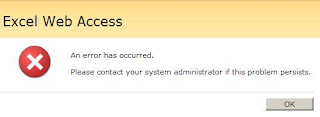
"Excel Web Access. An error has occurred. Please contact your system administrator if this problem persists."
Solution:
* SharePoint Central Administration > Operations > Services on Server > Excel Calculation Services
* Start the service
After adding an Excel Web Access Web Part to a SharePoint page, you receive the following error message:
"Excel Web Access. An error has occurred. Please contact your system administrator if this problem persists."

Solution:
* SharePoint Central Administration > Operations > Services on Server > Excel Calculation Services
* Start the service
Thursday, April 10, 2008
Links: SharePoint GearUp
A very good resource to examine during initiation of a SharePoint project:
SharePoint GearUp
http://sharepoint.microsoft.com/gearup/Pages/default.aspx
SharePoint GearUp
http://sharepoint.microsoft.com/gearup/Pages/default.aspx
SharePoint V3: Business Data Catalog, Setting Up Application Definition
Business Data Catalog, Setting Up Application Definition (Not Creating Application Definitions)
Service Accounts
Microsoft Single Sign-On & SharePoint Single Sign-On Service Account
* Minimum:
-Domain account -Central Administration, Farm Administrators Group
-SQL Server, Security Administrators Role
-SQL Server, DB_Creator Role
Enterprise Appliction Administrator Account
* Minimum:
-Domain Account
-Central Administration, Read Permissions
Microsoft Single Sign-On
Control Panel > Administrative Tools > Computer Management > Services and Applications > Services
* Microsoft Single Sign-On Service > Properties
-General, Startup type: Automatic
-General, Service Status: Start
-Log On, This Account: SSO Service Account
SharePoint Single Sign-On
Central Administration > Operations > Security Configuration > Manage Settings for Single Sign-On
* Server Settings > Manage Server Settings
-Account Name: SSO Service Account
* Server Settings > Enterprise Application Definition Settings > Manage settings for enterprise applciation definitions
-Account: SSO Service Account
SSP Permissions
SSP Administration Site > Site Actions > Site Settings > Users and Permissions
* Site Collection Administrators
-Site Collection Administrators: SSP Service Account
* Advanced Permissions > New > Add Users
-Users/Groups: SSP Service Account
-Give Permission: Full Control
Business Data Catalog Permissions
SSP Administration Site > Business Data Catalog > Business Data Catalog Permissions
* Manage Permissions > Add Users/Groups
-Choose Users: SSP Service Account
-Choose Permissions: Edit, Execute, Select in Clients, Set Permissions
* Manage Permissions > Add Users/Groups
-Choose Users: (add users as needed)
-Choose Permissions: (use permissions below, as appropriate)
Permissions
Edit: Select this permission to enable users to import application definitions and add, edit, or delete application definitions, business data types, and data fields for business data types.
Execute: Select this permission to enable users to change the properties of business data.
Select in Clients: Select this permission to enable the user to refer to business data types and fields in SharePoint lists, Web Parts, sites, and client applications.
Set permissions: Select this permission to enable the user to configure permissions for other users.
(Taken from Microsoft TechNet)
Register Enterprise Application Definitions
* Create application definition
* Import application definition
* Configure application definitino for Single Sign-On
SharePoint Single Sign-On for Application Definition
Central Administration > Operations > Security Configuration > Manage Settings for enterprise application definitions
* Server Settings > Enterprise Application Definition Settings > Manage account information enterprise applciation definitions
-Enterprise Application Definition, Account Information:
-Group Account Name: Group having Read Access to Application
-Enterprise Application Definition, Update account information: SSO Service Account
References:
Configure access to business data
http://technet2.microsoft.com/Office/en-us/library/a0d973ae-038d-491b-b76d-25dbf745d8931033.mspx
Configure single sign-on (Office SharePoint Server)
http://technet.microsoft.com/en-us/library/cc262932.aspx
Register business applications in the Business Data Catalog
http://technet2.microsoft.com/Office/en-us/library/97d1a614-84e7-45c2-9327-5749d5fc50111033.mspx
Service Accounts
Microsoft Single Sign-On & SharePoint Single Sign-On Service Account
* Minimum:
-Domain account -Central Administration, Farm Administrators Group
-SQL Server, Security Administrators Role
-SQL Server, DB_Creator Role
Enterprise Appliction Administrator Account
* Minimum:
-Domain Account
-Central Administration, Read Permissions
Microsoft Single Sign-On
Control Panel > Administrative Tools > Computer Management > Services and Applications > Services
* Microsoft Single Sign-On Service > Properties
-General, Startup type: Automatic
-General, Service Status: Start
-Log On, This Account: SSO Service Account
SharePoint Single Sign-On
Central Administration > Operations > Security Configuration > Manage Settings for Single Sign-On
* Server Settings > Manage Server Settings
-Account Name: SSO Service Account
* Server Settings > Enterprise Application Definition Settings > Manage settings for enterprise applciation definitions
-Account: SSO Service Account
SSP Permissions
SSP Administration Site > Site Actions > Site Settings > Users and Permissions
* Site Collection Administrators
-Site Collection Administrators: SSP Service Account
* Advanced Permissions > New > Add Users
-Users/Groups: SSP Service Account
-Give Permission: Full Control
Business Data Catalog Permissions
SSP Administration Site > Business Data Catalog > Business Data Catalog Permissions
* Manage Permissions > Add Users/Groups
-Choose Users: SSP Service Account
-Choose Permissions: Edit, Execute, Select in Clients, Set Permissions
* Manage Permissions > Add Users/Groups
-Choose Users: (add users as needed)
-Choose Permissions: (use permissions below, as appropriate)
Permissions
Edit: Select this permission to enable users to import application definitions and add, edit, or delete application definitions, business data types, and data fields for business data types.
Execute: Select this permission to enable users to change the properties of business data.
Select in Clients: Select this permission to enable the user to refer to business data types and fields in SharePoint lists, Web Parts, sites, and client applications.
Set permissions: Select this permission to enable the user to configure permissions for other users.
(Taken from Microsoft TechNet)
Register Enterprise Application Definitions
* Create application definition
* Import application definition
* Configure application definitino for Single Sign-On
SharePoint Single Sign-On for Application Definition
Central Administration > Operations > Security Configuration > Manage Settings for enterprise application definitions
* Server Settings > Enterprise Application Definition Settings > Manage account information enterprise applciation definitions
-Enterprise Application Definition, Account Information:
-Group Account Name: Group having Read Access to Application
-Enterprise Application Definition, Update account information: SSO Service Account
References:
Configure access to business data
http://technet2.microsoft.com/Office/en-us/library/a0d973ae-038d-491b-b76d-25dbf745d8931033.mspx
Configure single sign-on (Office SharePoint Server)
http://technet.microsoft.com/en-us/library/cc262932.aspx
Register business applications in the Business Data Catalog
http://technet2.microsoft.com/Office/en-us/library/97d1a614-84e7-45c2-9327-5749d5fc50111033.mspx
Saturday, March 15, 2008
Keyboard Shortcuts
LOCAL SYSTEM
ALT + Space Bar : Display Windows menu
ALT + F : Display file menu
Alt + Tab : Toggle between open windows
ALT + Underlined Letter : Display the corresponding menu
CTRL + A : Select all
CTRL + C : Copy
CTRL + ESC : Display Start menu
CTRL + P : Print
CTRL + S : Save
CTRL + V : Paste
CTRL + X : Cut
CTRL + Z : Undo
CTRL + Shift + Arrow Key : Select a block of text
CTRL + Shift + ESC : Display Task Manager
Shift + Delete : Delete files permanently
Shift + End : Highlight from current cursor position to the end of the line
Shift + Home : Highlight from current cursor position to beginning of the line
CTRL + Home : Put cursor at beginning of the document
Windows Key + E : Display My Computer folder
Windows Key + F : Find files or folders
Windows Key + F1 : Display Help and Support
Windows Key + L : Lock the keyboard
Windows Key + M : Minimize window
Windows Key + Shift + M : Restore minimized window
Windows Key + R : Display user command line
REMOTE DESKTOP
CTRL + ALT + END : Task Manager
ALT + Page Up or ALT + Page Down : Toggle Windows
CTRL + ALT + "+" : Screen Print of Remote Desktop (Local Clipboard)
CTRL + ALT + "-" : Screen Print of Remote Desktop (Remote Desktop Clipboard)
ALT + Space Bar : Display Windows menu
ALT + F : Display file menu
Alt + Tab : Toggle between open windows
ALT + Underlined Letter : Display the corresponding menu
CTRL + A : Select all
CTRL + C : Copy
CTRL + ESC : Display Start menu
CTRL + P : Print
CTRL + S : Save
CTRL + V : Paste
CTRL + X : Cut
CTRL + Z : Undo
CTRL + Shift + Arrow Key : Select a block of text
CTRL + Shift + ESC : Display Task Manager
Shift + Delete : Delete files permanently
Shift + End : Highlight from current cursor position to the end of the line
Shift + Home : Highlight from current cursor position to beginning of the line
CTRL + Home : Put cursor at beginning of the document
Windows Key + E : Display My Computer folder
Windows Key + F : Find files or folders
Windows Key + F1 : Display Help and Support
Windows Key + L : Lock the keyboard
Windows Key + M : Minimize window
Windows Key + Shift + M : Restore minimized window
Windows Key + R : Display user command line
REMOTE DESKTOP
CTRL + ALT + END : Task Manager
ALT + Page Up or ALT + Page Down : Toggle Windows
CTRL + ALT + "+" : Screen Print of Remote Desktop (Local Clipboard)
CTRL + ALT + "-" : Screen Print of Remote Desktop (Remote Desktop Clipboard)
Friday, February 29, 2008
SharePoint V3: Records Center: Created
When you send a document from a SharePoint site to a MOSS 2007 Records Center document library, the "Created" date reflects the date and time that the document was received by the Records Center document library, not the date and time the document was originally created in its native document library.
SharePoint V3: Search: “The search request was unable to connect to the Search Service”
Description:
Error: “The search request was unable to connect to the Search Service”
Solution:
Step 1
* Central Admin > Application Management > Office SharePoint Server Shared Services > Create or Configure this farm's shared services
* Shared Services Provider (drop down) > Edit Properties
* Edit Shared Services Provider > Index Server: Verify the index server is set
Step 2
Single Server Farm
On the MOSS 2007 server:
* Start > Run > CMD > stsadm.exe -o osearch -action stop
* Start > Run > CMD > stsadm.exe -o osearch -action start -role queryindex
Multiple Server Farm
On the MOSS 2007 Front End Web/Query server:
* Start > Run > CMD > stsadm.exe -o osearch -action stop
On the MOSS 2007 Index server:
* Start > Run > CMD > stsadm.exe -o osearch -action stop
On the MOSS 2007 Index server:
* Start > Run > CMD > stsadm.exe -o osearch -action start -role index
On the MOSS 2007 Front End Web/Query server:
* Start > Run > CMD > stsadm.exe -o osearch -action start -role query
Error: “The search request was unable to connect to the Search Service”
Solution:
Step 1
* Central Admin > Application Management > Office SharePoint Server Shared Services > Create or Configure this farm's shared services
* Shared Services Provider (drop down) > Edit Properties
* Edit Shared Services Provider > Index Server: Verify the index server is set
Step 2
Single Server Farm
On the MOSS 2007 server:
* Start > Run > CMD > stsadm.exe -o osearch -action stop
* Start > Run > CMD > stsadm.exe -o osearch -action start -role queryindex
Multiple Server Farm
On the MOSS 2007 Front End Web/Query server:
* Start > Run > CMD > stsadm.exe -o osearch -action stop
On the MOSS 2007 Index server:
* Start > Run > CMD > stsadm.exe -o osearch -action stop
On the MOSS 2007 Index server:
* Start > Run > CMD > stsadm.exe -o osearch -action start -role index
On the MOSS 2007 Front End Web/Query server:
* Start > Run > CMD > stsadm.exe -o osearch -action start -role query
Tuesday, January 29, 2008
SharePoint V3: When To/When Not To Use Content Types
Content types allow you to structure documents and list items in a SharePoint portal. They give the functional ability to define and enforce uniformity throughout a portal. There is no question that content types greatly enrich SharePoint as a content management product. However, in determining when to use content types in a portal, there are several considerations.
Is there a sense of unity amongst business units or are they segmented?
Are the business units of the organization integrated in their nomenclature (or even individuals within a business unit)?
How easy is it to communicate ideas accross business units or within a buisness unit?
Resources Allowed for Design
Does the organization have the people and intellectual bandwidth, and focus to figure out how to categorize document and list types, provide name for content types, determine format of each content type?
Governance
Is there a system of checks and balances, perhaps a design committee, in place for change management to ensure that pros and cons have been properly weighed prior to making design changes?
Organizational Adoption
Will the producers and consumers of the content accept a consistent structure for their content, or will they shy away or complain about it?
Will the users understand the content if it is categorized?
Skill
Are the content producers and their supporting power users familiar with SharePoint enough, and trusted enough by peers to create content types, associate templates, and add the content types to libraries?
...these represent some of the overarching ideas that come into play when trying to determine when to use content types.
Here are some of the technical considerations:
Site Structure
Does the portal design include one site collection or many?
Do the content types span accross site collections?
Content types work well within a site collection. But, when your content types span several site collections then it becomes a little tedious keeping the content type definitions in synch with each other.
Custom List or Document Library W/Multiple Content Types + DataSheet View + Unique Columns on View = Users can apply values to metadata columns that don't actually exist for a content type, and the metadata actually gets stored (no hard damage, just not clean)
Benefits of Content Types
* Allows you to name types of content
* Makes consistent metadata structure for each type of content
* Allows you to associate a unique document template
* New button shows the name of the content type instead of generic New Document or New Item
* Allows you to define parent/child relationships, allowing you to create a logical tree structure for taxonomy design
* Allows you to easily provision a new custom list or document library, the columns are already defined in the content type, just add the content type
* IE Script Error (mentioned above)
* Orphaned Data (mentioned above)
* No easy way to synchronize accross site collections (can use PowerShell to export/import)
* No security gains, not able to secure content types, still done at item or library level
Site Columns Without Content Types
* Great middle of the road, save time by predefining columns in a site collection, but avoid some of the technical issues with content types
* Limits you to one document template per library (back to the generic new button)
* Limits you in that all items or documents in a list or library now must have the same columns as each other
Desire
Is there a knowledge management champion who can coordinate the effort of unifying a business unit or entire company?
Executive Sponsorship/Authority
Do the resources who have the desire to standardize content also have the authority within a department (or broader scope) to make descisions and execute changes (or the backing of an executive sponsor)?
Is there a sense of unity amongst business units or are they segmented?
Are the business units of the organization integrated in their nomenclature (or even individuals within a business unit)?
How easy is it to communicate ideas accross business units or within a buisness unit?
Resources Allowed for Design
Does the organization have the people and intellectual bandwidth, and focus to figure out how to categorize document and list types, provide name for content types, determine format of each content type?
Governance
Is there a system of checks and balances, perhaps a design committee, in place for change management to ensure that pros and cons have been properly weighed prior to making design changes?
Organizational Adoption
Will the producers and consumers of the content accept a consistent structure for their content, or will they shy away or complain about it?
Will the users understand the content if it is categorized?
Skill
Are the content producers and their supporting power users familiar with SharePoint enough, and trusted enough by peers to create content types, associate templates, and add the content types to libraries?
...these represent some of the overarching ideas that come into play when trying to determine when to use content types.
Here are some of the technical considerations:
Site Structure
Does the portal design include one site collection or many?
Do the content types span accross site collections?
Content types work well within a site collection. But, when your content types span several site collections then it becomes a little tedious keeping the content type definitions in synch with each other.
Portability
Since templates and site exports (.cmp) can rely on content types, which means you need to set up the content types on multiple site collections.
Custom List or Document Library W/Multiple Content Types + DataSheet View + Unique Columns on View = Users can apply values to metadata columns that don't actually exist for a content type, and the metadata actually gets stored (no hard damage, just not clean)
Benefits of Content Types
* Allows you to name types of content
* Makes consistent metadata structure for each type of content
* Allows you to associate a unique document template
* New button shows the name of the content type instead of generic New Document or New Item
* Allows you to define parent/child relationships, allowing you to create a logical tree structure for taxonomy design
* Allows you to easily provision a new custom list or document library, the columns are already defined in the content type, just add the content type
* IE Script Error (mentioned above)
* Orphaned Data (mentioned above)
* No easy way to synchronize accross site collections (can use PowerShell to export/import)
* No security gains, not able to secure content types, still done at item or library level
Site Columns Without Content Types
* Great middle of the road, save time by predefining columns in a site collection, but avoid some of the technical issues with content types
* Limits you to one document template per library (back to the generic new button)
* Limits you in that all items or documents in a list or library now must have the same columns as each other
Wednesday, January 16, 2008
SharePoint V3: Move Web Application's Virtual Directory Location
Description:
You do not like the location of a MOSS web application's virtual directory. For example, maybe it was originally configured in a default location (e.g. C:\Inetpub\WWWRoot\WSS\VirtualDirectories\). Whatever the case, you would like to move a MOSS web application's virtual directory to a new location.
Solution:
* Backup the source web application and associated site collections (e.g. SQL backup, stsadm site collection backup)
* Create a new web application
Central Admin > Application Management > Create or Extend Web Application
* In the "Create New Web Application" screen, configure the IIS Web Site path to point to the desired location (e.g. D:\VirtualDirectories\)
* Give the new web application a temporary URL (e.g. http://server:port).
* Migrate the content database of the source web application, or restore the site collections of the source web application to the new web application
* Remove the IIS host headers from the source web application, give the source web application a temporary URL (e.g. http://server:port).
* Remove the External URL and alternate access mappings of the source web application.
* Configure IIS host headers on the new web application.
* Configure External URL and alternate access mappings on new web application.
* Delete the source web application.
At this point the web application is restored and has the desired virtual directory file location.
You do not like the location of a MOSS web application's virtual directory. For example, maybe it was originally configured in a default location (e.g. C:\Inetpub\WWWRoot\WSS\VirtualDirectories\). Whatever the case, you would like to move a MOSS web application's virtual directory to a new location.
Solution:
* Backup the source web application and associated site collections (e.g. SQL backup, stsadm site collection backup)
* Create a new web application
Central Admin > Application Management > Create or Extend Web Application
* In the "Create New Web Application" screen, configure the IIS Web Site path to point to the desired location (e.g. D:\VirtualDirectories\)
* Give the new web application a temporary URL (e.g. http://server:port).
* Migrate the content database of the source web application, or restore the site collections of the source web application to the new web application
* Remove the IIS host headers from the source web application, give the source web application a temporary URL (e.g. http://server:port).
* Remove the External URL and alternate access mappings of the source web application.
* Configure IIS host headers on the new web application.
* Configure External URL and alternate access mappings on new web application.
* Delete the source web application.
At this point the web application is restored and has the desired virtual directory file location.
Friday, January 11, 2008
SharePoint V3: Error: Creating Web Application Error
Description
Central Admin > Application Management > Create a Web Application
Error: The path specified cannot be used at this time. (Exception from HRESULT: 0x80070094)

Central Admin > Application Management > Create a Web Application
Error: The path specified cannot be used at this time. (Exception from HRESULT: 0x80070094)

Solution
Start > Run > iisreset /noforce
SharePoint V3: Content Type Cons
Ok, so I have spent the last week recreating a SharePoint business application and corresponding Records Center because there still isn't a post SP1 hotfix for the MOSS2007/ContentTypes/Office 2003 compatibility issue.
One thing I did learn in this process is that if you are trying to work around this issue, then removing content types from your libraries is not the way to go. If you disable content types from your document libraries, you will still get the IE script error. You actually have to create new document libraries and leave content types disabled. This means adding site columns directly to the libraries. It also means recreating all the views.
I guess the silver lining to going no content types is at least you are able to template your libraries again. I'm beginning to shift my opinion about content types. They still sound great in a whiteboard design session, but in my recent experiences, they are more trouble than they are worth.
Content Types Cons:
* Cause document libraries to be incompatible with Office 2003
* In a sense, invalidate (or at least limit) document library templates in a multi site collection environment because templates taken are dependant on Content Type which are tied to site collection
* Allow datasheet view users to apply meta data to metadata columns that don't exist
* Are not securable (as sites, web parts, items are)
One thing I did learn in this process is that if you are trying to work around this issue, then removing content types from your libraries is not the way to go. If you disable content types from your document libraries, you will still get the IE script error. You actually have to create new document libraries and leave content types disabled. This means adding site columns directly to the libraries. It also means recreating all the views.
I guess the silver lining to going no content types is at least you are able to template your libraries again. I'm beginning to shift my opinion about content types. They still sound great in a whiteboard design session, but in my recent experiences, they are more trouble than they are worth.
Content Types Cons:
* Cause document libraries to be incompatible with Office 2003
* In a sense, invalidate (or at least limit) document library templates in a multi site collection environment because templates taken are dependant on Content Type which are tied to site collection
* Allow datasheet view users to apply meta data to metadata columns that don't exist
* Are not securable (as sites, web parts, items are)
Monday, January 07, 2008
Links: CodePlex SPSReport
CodePlex SPSReport Releases
http://www.codeplex.com/spsreport/Release/ProjectReleases.aspx?ReleaseId=5706
Quick Instructions
* Download SPSReport
* Install
* Run
* Select your version of SharePoint
* Select option 4 to capture all events
http://www.codeplex.com/spsreport/Release/ProjectReleases.aspx?ReleaseId=5706
Quick Instructions
* Download SPSReport
* Install
* Run
* Select your version of SharePoint
* Select option 4 to capture all events
Links: Microsoft Process Monitor
Microsoft TechNet Process Monitor v1.26 http://www.microsoft.com/technet/sysinternals/processesandthreads/processmonitor.mspx
Sunday, January 06, 2008
SharePoint V3: Preparing for MOSS 2007 Service Pack 1
As I am about to begin testing MOSS 2007 SP1 in some environments ahead of production deployment, I began to ask myself some questions so that I could be more prepared:
Q. What version number is WSS 3.0 SP1 and MOSS 2007 SP1?
A. 12.0.0.6219
Q. Are there any known issues with MOSS 2007 SP1?
A.
KBAlertz.com: After you install the 2007 Office System Servers SP1 or Windows SharePoint Services 3.0 SP1 on a server that has the Foxit PDF IFilter installed, .pdf document types are not indexed
http://kbalertz.com/944447/After-install-Office-System-Servers-Windows-SharePoint-Services-server-Foxit-IFilter-document-types-indexed.aspx
KBAlertz.com: Error message when you try to install 2007 Office System Servers Service Pack 1 (SP1) on a computer that also has Project Server 2007 installed
http://kbalertz.com/944446/Error-message-install-Office-System-Servers-Service-computer-Project-Server-installed.aspx
KBAlertz.com: After you install SharePoint Server 2007 Service Pack 1, the maximum disk space that is used on a query server or on an index server increases to 2.85 times the physical size of the index
http://kbalertz.com/943105/After-install-SharePoint-Server-Service-maximum-space-query-server-index-server-increases-times-physical-index.aspx
Q. What version number is WSS 3.0 SP1 and MOSS 2007 SP1?
A. 12.0.0.6219
Q. Are there any known issues with MOSS 2007 SP1?
A.
KBAlertz.com: After you install the 2007 Office System Servers SP1 or Windows SharePoint Services 3.0 SP1 on a server that has the Foxit PDF IFilter installed, .pdf document types are not indexed
http://kbalertz.com/944447/After-install-Office-System-Servers-Windows-SharePoint-Services-server-Foxit-IFilter-document-types-indexed.aspx
KBAlertz.com: Error message when you try to install 2007 Office System Servers Service Pack 1 (SP1) on a computer that also has Project Server 2007 installed
http://kbalertz.com/944446/Error-message-install-Office-System-Servers-Service-computer-Project-Server-installed.aspx
KBAlertz.com: After you install SharePoint Server 2007 Service Pack 1, the maximum disk space that is used on a query server or on an index server increases to 2.85 times the physical size of the index
http://kbalertz.com/943105/After-install-SharePoint-Server-Service-maximum-space-query-server-index-server-increases-times-physical-index.aspx
Links: SharePoint V3: Performance, Configuring Caching
Microsoft TechNet: Additional performance and capacity planning factors (Office SharePoint Server)
http://technet2.microsoft.com/Office/en-us/library/9f3cfe3f-01b5-406e-8615-04735ae422861033.mspx?mfr=true
Microsoft Office Online: Configure object cache settings
http://office.microsoft.com/en-us/sharepointserver/HA101577831033.aspx
MSDN: Object Caching
http://msdn2.microsoft.com/en-US/library/aa622758.aspx
http://technet2.microsoft.com/Office/en-us/library/9f3cfe3f-01b5-406e-8615-04735ae422861033.mspx?mfr=true
Microsoft Office Online: Configure object cache settings
http://office.microsoft.com/en-us/sharepointserver/HA101577831033.aspx
MSDN: Object Caching
http://msdn2.microsoft.com/en-US/library/aa622758.aspx
Thursday, January 03, 2008
Links: Microsoft Network Monitor
Download Microsoft Network Monitor 3.1
http://www.microsoft.com/downloads/details.aspx?FamilyID=18b1d59d-f4d8-4213-8d17-2f6dde7d7aac&displaylang=en
Microsoft Help and Support: How to use Network Monitor to capture network traffic
http://support.microsoft.com/kb/812953
Microsoft Help and Support: How to capture network traffic with Network Monitor
http://support.microsoft.com/kb/148942
http://www.microsoft.com/downloads/details.aspx?FamilyID=18b1d59d-f4d8-4213-8d17-2f6dde7d7aac&displaylang=en
Microsoft Help and Support: How to use Network Monitor to capture network traffic
http://support.microsoft.com/kb/812953
Microsoft Help and Support: How to capture network traffic with Network Monitor
http://support.microsoft.com/kb/148942
Subscribe to:
Posts (Atom)


